

Commercial Ice Maker Guide: Features, Setup & Safety

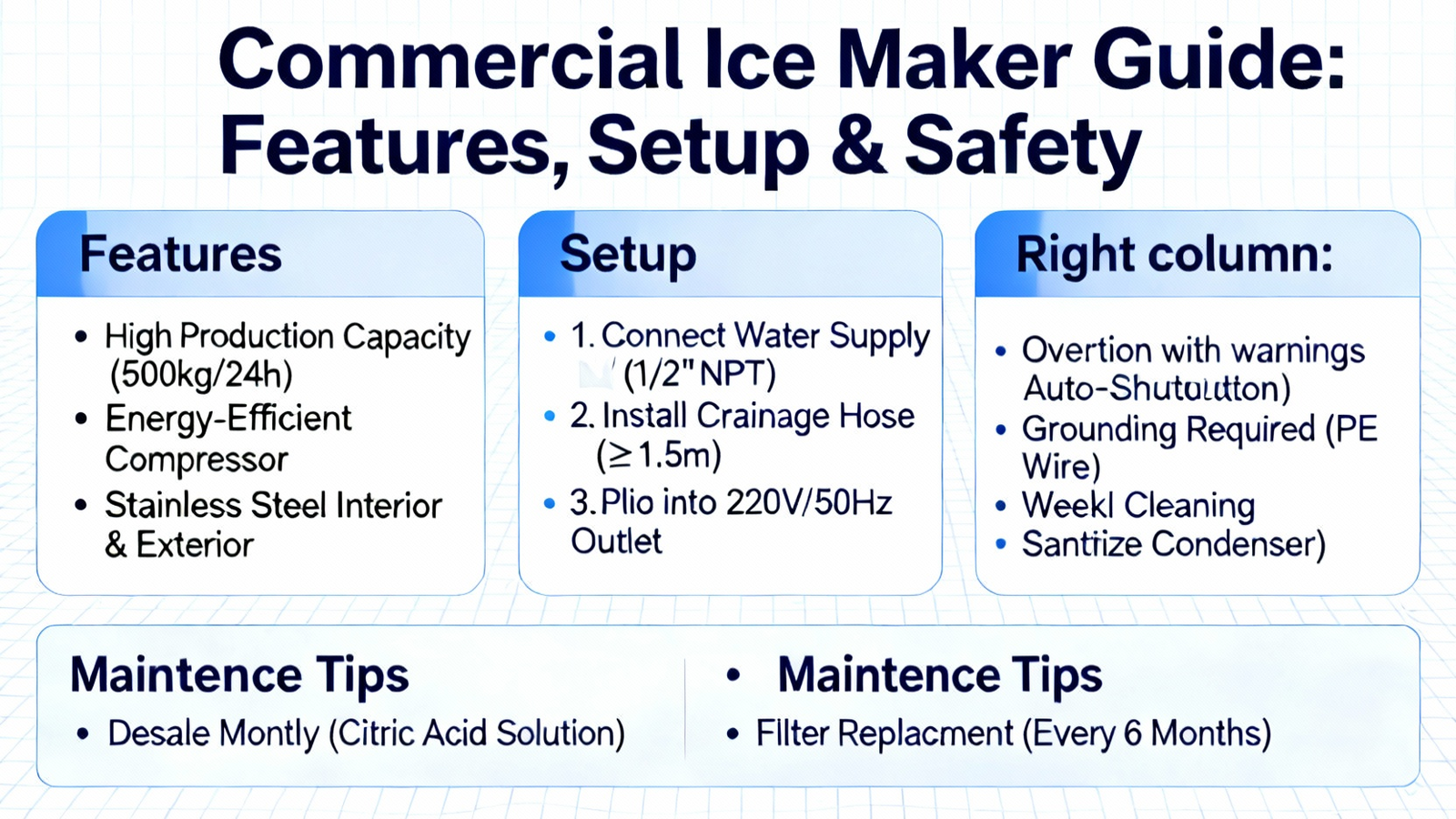
Heavy-Duty Commercial Ice Maker: Ultimate Guide to Features & Setup
For restaurants, bars, and hotels, a reliable ice supply is non-negotiable. This guide delves into the specifics of a robust, stainless steel commercial ice maker, detailing its key features, critical installation requirements, and essential safety protocols to ensure optimal performance and longevity in a demanding foodservice environment.
Engineering for Commercial Endurance
Built for high-volume operations, this ice maker’s durable stainless steel construction is the industry standard for corrosion resistance and easy sanitation, crucial for health code compliance. Its operation on standard 110V 60Hz power (780W) makes it versatile for most US commercial kitchens without requiring special electrical work. A significant modern feature is the use of R290 (propane) refrigerant. According to Wikipedia, R290 has a “negligible ozone depletion potential and very low global warming potential” compared to traditional hydrofluorocarbons (HFCs), making it an environmentally progressive choice. Its compatibility with climate types SN, N, and ST ensures reliable performance across varied US regional temperatures.
Critical Pre-Installation and Safety Protocols
Proper setup is paramount for safety and efficiency. The unit requires a potable drinking water supply with precise pressure (14.5-58 PSI). As noted in a Reddit discussion on r/refrigeration, improper water pressure is a common cause of ice maker issues, leading to scale buildup or mechanical failure. Safety mandates include maintaining a 5.9-inch clearance on all sides for airflow, avoiding extension cords to prevent fire risk, and keeping the unit away from heat sources and flammable materials. Importantly, after delivery, the unit must stand upright for 24 hours to let the compressor oil settle—a step often emphasized by professionals to prevent immediate compressor failure.
Optimizing Operation and Drainage
Long-term reliability hinges on correct water and waste management. The machine’s gravity-fed drainage system requires the drain pipe outlet to be lower than the machine’s port, a principle confirmed by basic plumbing guidelines. Furthermore, the note that “the surrounding environmental temperature will influence the time of ice making” is a key thermodynamic reality; higher ambient temperatures force the compressor to work harder, reducing efficiency. This makes placement in a cool, well-ventilated area, away from direct sunlight or cooking equipment, a direct contributor to the machine’s output and lifespan. For a model embodying these robust features, consider the heavy-duty commercial ice maker designed for such demands.
Conclusion: A Strategic Investment for Your Business
Selecting and installing a commercial stainless steel ice maker is a significant operational decision. This unit’s construction with durable materials and eco-friendly R290 refrigerant positions it as a modern, responsible choice. However, its technical specifications—from voltage and climate compatibility to water pressure requirements—must align with your facility’s infrastructure. The extensive safety and setup notes are not mere suggestions but essential guidelines to protect your investment and ensure uninterrupted service. As highlighted by industry discussions, neglecting fundamentals like clearance, proper drainage, and the mandatory 24-hour settling period can lead to costly downtime. By understanding its engineering, respecting the installation protocols, and optimizing its operating environment, this heavy-duty ice maker becomes more than an appliance; it becomes a reliable, high-performance asset that supports the daily rhythm of your foodservice or hospitality business, ensuring you never run short of this essential commodity.
This guide really highlights why a heavy-duty commercial ice maker is such a crucial investment for busy food service operations.
\}}
This guide really highlights why a heavy-duty commercial ice maker is such a crucial investment for busy food service operations.
\}}
This guide really highlights why a heavy-duty commercial ice maker is such a crucial investment for busy food service operations.
\}}
This guide really highlights why a heavy-duty commercial ice maker is such a crucial investment for busy food service operations.
\}}
This guide is a great breakdown of the key features to look for in a heavy-duty commercial ice maker.
\}}
This guide is a great breakdown of the key features to look for in a heavy-duty commercial ice maker.
\}}
This guide is a great breakdown of the key features to look for in a heavy-duty commercial ice maker.
\}}
This guide is a great breakdown of the key features to look for in a heavy-duty commercial ice maker.
\}}