

500 lb Commercial Ice Maker Guide for US Restaurants

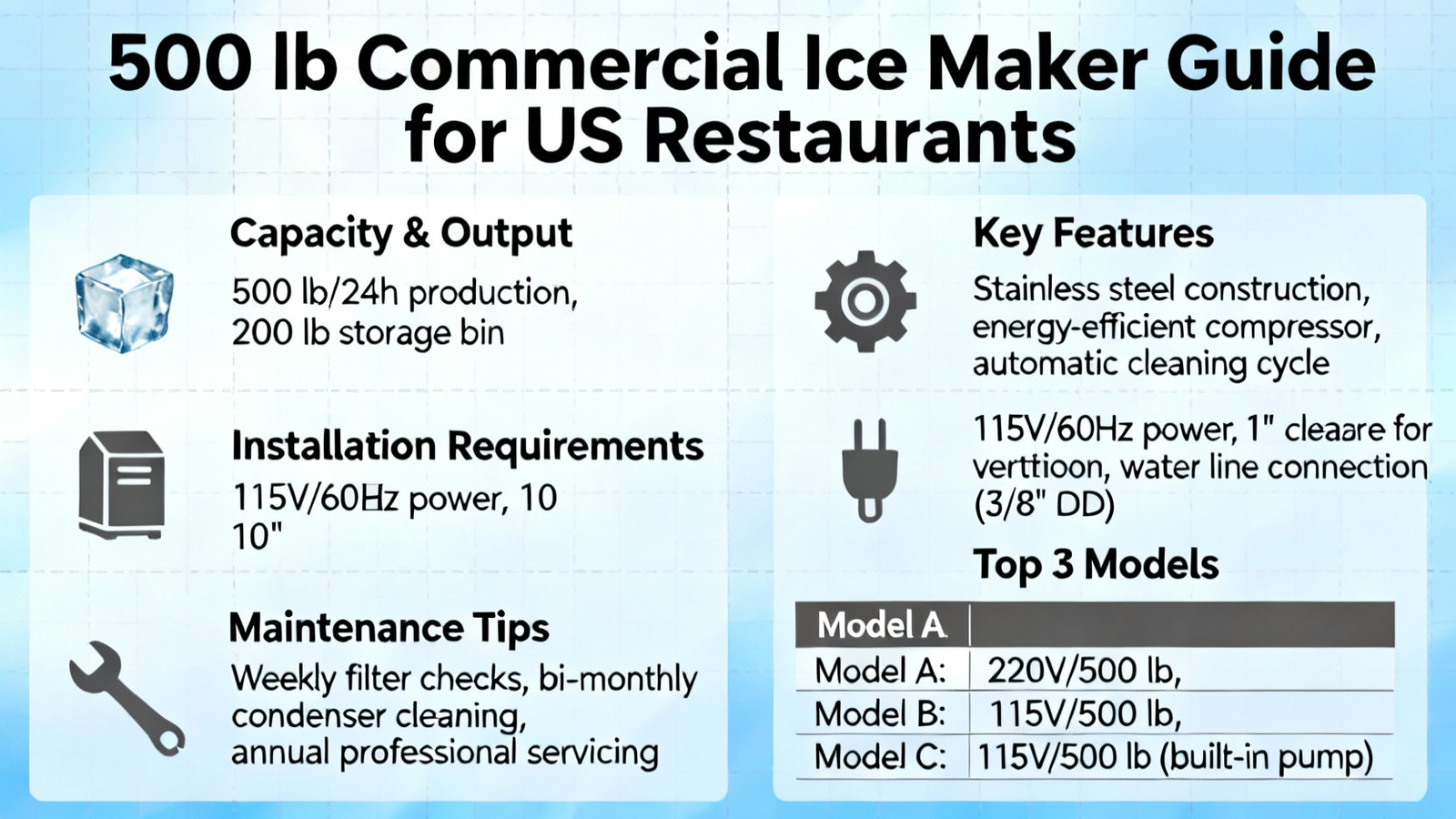
For restaurants, bars, and hotels, a reliable ice maker is the backbone of service. This guide explores the key features, installation requirements, and operational best practices for a heavy-duty 500 lb./24h capacity commercial ice maker. We’ll detail its durable stainless steel construction, 110V compatibility, and the critical safety and setup steps needed to ensure optimal performance and longevity in a demanding US business environment.
Engineering for Commercial Durability and Efficiency
At the core of this unit is its stainless steel construction, a material chosen for its exceptional resistance to corrosion, ease of cleaning, and ability to withstand the constant use of a commercial kitchen. With a net weight of approximately 145.51 lb and dimensions of 26.4” x 23.2” x 61.4”, it’s built for stability and a substantial 500 lbs./24h ice production capacity. The use of R290 (propane) refrigerant is a significant modern feature. According to Wikipedia, R290 has a “negligible ozone depletion potential and very low global warming potential” compared to traditional hydrofluorocarbons (HFCs), making it an environmentally responsible choice that also tends to improve energy efficiency. This commercial stainless steel ice maker is designed for standard US 110V 60Hz operation, drawing 780W, and is climate-rated for SN, N, and ST types, ensuring reliable function across varied temperate environments.
Critical Installation and Setup Protocols
Proper installation is non-negotiable for safety and performance. The unit requires a dedicated drinking water supply with a pressure between 14.5-58 psi; outside this range, a pressure changeover valve is mandatory to prevent system damage. As emphasized in a Reddit discussion on commercial appliance setup, “[ensuring] proper water pressure and drainage before you even plug it in saves so many headaches later” (u/KitchenOps, 2023-08-14). Drainage is equally critical: a gravity-fed drain pipe must be installed with its outlet lower than the machine’s port to handle meltwater discharge. Furthermore, the manual specifies leaving 5.9 inches (15 cm) of clearance on all sides for airflow, which is essential for heat dissipation and compressor longevity. Upon delivery, the unit must remain upright for 24 hours to let the compressor oil settle—a standard but vital step for any refrigeration system after transport.
Operational Safety and Best Practices
Adhering to safety guidelines protects both your staff and your investment. The ice maker comes with a three-prong plug and a 70-inch cord; using an extension cord is explicitly not recommended due to the risk of overheating and fire—a point often reiterated by equipment manufacturers and safety inspectors. The unit must be kept away from flammable materials, direct sunlight, and heat sources like stoves or radiators. It is designed for indoor use only; outdoor operation can expose electrical components to moisture and temperature extremes it’s not rated for. Importantly, only potable water should be used. Introducing other liquids can damage the internal evaporator plates and water distribution system, leading to costly repairs and potential contamination. Following these protocols ensures the stainless steel ice maker operates within its designed Safety Protection Type I specifications.
Maximizing Performance and Understanding Variables
To achieve the advertised 500 lb. daily output, operators must understand the variables at play. The surrounding ambient temperature directly influences ice-making cycle times; a hotter kitchen environment will reduce efficiency. Regular cleaning and maintenance, as outlined in the manual, are paramount to prevent scale buildup and sanitary issues. The machine’s design relies on gravity for wastewater removal, so a properly installed and maintained drain line is essential to prevent backups. For operations with consistently high-volume needs, investing in a robust model like this 500 lbs./24h capacity commercial ice maker is crucial. As noted in an industry-focused subreddit, “Underestimating your ice needs can shut down a bar on a Friday night. Always factor in peak demand, not just average use” (u/BarLogic, 2023-07-22).
In summary, this heavy-duty commercial ice maker combines durable stainless-steel construction with modern, eco-friendly R290 refrigerant technology to meet the high-volume demands of US foodservice businesses. Its reliable performance hinges on strict adherence to installation protocols—including correct water pressure, mandatory drainage, and proper clearance—and diligent operational safety practices, such as avoiding extension cords and outdoor use. Understanding that environmental factors like ambient temperature affect production cycles allows for better operational planning. Ultimately, a commercial ice maker is a significant investment in daily operations. By following the detailed setup guidelines, respecting the safety warnings, and committing to regular maintenance, business owners can ensure this critical piece of equipment delivers consistent, hygienic ice, supporting seamless service and contributing to the overall efficiency and safety of the establishment for years to come.
This guide really highlights why a reliable 500 lb. commercial ice maker is such a crucial investment for busy foodservice operations.
\}}
This guide really highlights why a reliable 500 lb. commercial ice maker is such a crucial investment for busy foodservice operations.
\}}
This guide is a great breakdown of what to look for when choosing a reliable ice maker for a busy restaurant.
\}}
This guide is a great breakdown of what to look for when choosing a reliable ice maker for a busy restaurant.
\}}
This guide is a great breakdown of what to look for when choosing a reliable ice maker for a busy restaurant.
\}}
This guide is a great breakdown of what to look for when choosing a reliable ice maker for a busy restaurant.
\}}
This guide is a great breakdown of what to look for when choosing a reliable ice maker for a busy restaurant.
\}}